


Protecting the Pollinators That Feed the World
December 16, 2025
35% of the world’s food crops depend on animal pollinators to reproduce. That’s one out of every three bites of food eaten. Pollinators contribute $23 billion worth of agricultural products. However, across the country, commercial beekeeping operations reported an average loss of 62% in commercial honey bee colonies between June 2024 and February 2025.
“Honey bees are the pollinator backbone of the United States agricultural sector, as well as the world. Without the pollinators, we don't have food,” said Kevin Langley, Vice President of the Louisiana Beekeepers Association and a 1987 LSU graduate.
Louisiana plays a crucial role in beekeeping, pollination, and food consumed throughout the nation and the world.
— Video by Grant French
“Our bees are transported around the U.S., called migratory beekeeping, and pollinate almonds in California, fruits and vegetables on the East Coast, citrus in Florida, and apples in Washington state,” said Langley.
A collaboration between LSU and the USDA-ARS Honey Bee Breeding, Genetics and Physiology Research Unit is at the forefront of research and discovery aimed at improving the health of honey bees.
“Here at the USDA-ARS Honey Bee Breeding, Genetics and Physiology Research Unit, we really focus on making honey bees healthier using their own traits and behaviors, and how management might change depending on the types of bees that were used,” said Michael Simone-Finstrom, Research Molecular Biologist with the U.S. Department of Agriculture, or USDA. “We’re working on managing healthy bees, developing healthy bees that are great for the industry, great for food production, and great for beekeepers.”
“The USDA-ARS Honey Bee Breeding, Genetics and Physiology Research Unit is one of the most important bee labs in the entire world, and it's located right here in Baton Rouge,” Langley said. “It's one of Louisiana's best-kept secrets for more than 97 years, with some of the best scientists in the world collaborating with LSU, from postdoctoral students to undergrads, to help solve the honey bee problem.”
Researching a Honey Bee Threat
Since 2017, the USDA-ARS Honey Bee Breeding, Genetics and Physiology Research Unit and researchers with the LSU AgCenter have been leading a major effort to take on one of the biggest threats to honey bee health: the parasitic varroa mite.
“The USDA-ARS Honey Bee Breeding, Genetics and Physiology Research Unit is one of Louisiana's best-kept secrets for more than 97 years, with some of the best scientists in the world collaborating with LSU, from postdoctoral students to undergrads, to help solve the honey bee problem.”
Kevin Langley, Vice President of the Louisiana Beekeepers Association
“It is a big problem for all beekeepers, commercial beekeepers, and small-scale beekeepers,” said Joseph McCarthy, an LSU AgCenter Extension Associate. “Many of the issues become more evident when the colonies are overwintered. If a colony is sick or diseased going into the winter, it might not survive in the spring. And that's a big problem for beekeepers who are going to move their colonies for pollination or use their colonies for honey production, because they then have to spend a lot of money recuperating these colonies, requeening, and resetting up for the next year.”
Through a USDA National Institute of Food and Agriculture USDA National Institute of Food and Agriculture grant, the team has been developing and testing bees bred specifically to resist the mite, which feeds on both developing and adult bees and spreads harmful viruses.
“This parasitic mite is ultimately responsible for most colony deaths,” Simone-Finstrom said. “Overall, colonies have been dying at alarming rates over the last 10 years. This mite was introduced in the 1980s and has been a major driver of colony loss in the industry since its arrival. Our big goals are to develop bees and management techniques that allow the bees to defend themselves against this parasite.”
Shaping the Next Generation of Researchers
LSU students are involved in the research conducted at the USDA-ARS Honey Bee Breeding, Genetics and Physiology Research Unit.
“Research is really a team effort. We can't do it alone. It requires a lot of people with diverse expertise, ranging from undergraduates just starting out to scientists with 30 years of experience. Bringing all these different backgrounds together really does help. No one research project is going to be done by a single person,” said Simone-Finstrom.
PhD Student Hasim Hakanoglu chose LSU specifically because of the relationship between LSU and the USDA-ARS Honey Bee Breeding, Genetics and Physiology Research Unit.
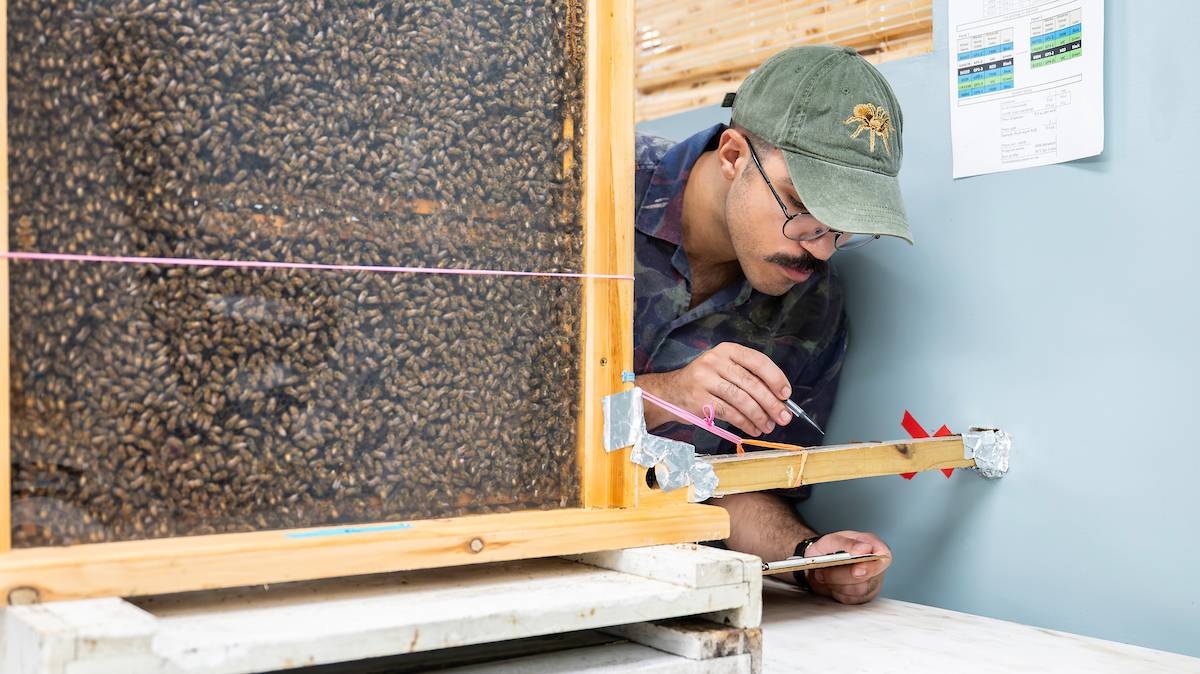
PhD Student Hasim Hakanoglu chose LSU specifically because of the relationship between LSU and the USDA-ARS Honey Bee Breeding, Genetics and Physiology Research Unit.
“The lab here is the most well-established, biggest federal honey bee unit, and it has access to a variety of unique bee populations, expertise on cutting-edge research and equipment, and I wanted to use these populations for my research,” Hakanoglu said.
Hakanoglu’s research is taking a closer look at selective breeding.
“We've been breeding bees for thousands of years. I’m researching how selective breeding shapes certain life history traits or behaviors in honey bees. For example, how long they live, when they stop foraging, and what they forage, from a behavioral aspect. For a genetic aspect, we're looking at how genes are changing in response to the selective breeding that we are performing.”
Ally Martin, a PhD student studying entomology, is studying the impacts of natural products on managed honey bee health. Martin studies bee nutrition, immunity, and disease resistance, focusing on natural feed additives that can do more than nourish bees—potentially boosting their immune systems and helping them fight diseases.
“I've been very lucky to be able to work with so many wonderful students, so many professors, and research scientists here at the lab. If I had to pick one word from my experience, it would be collaborative,” Martin said.
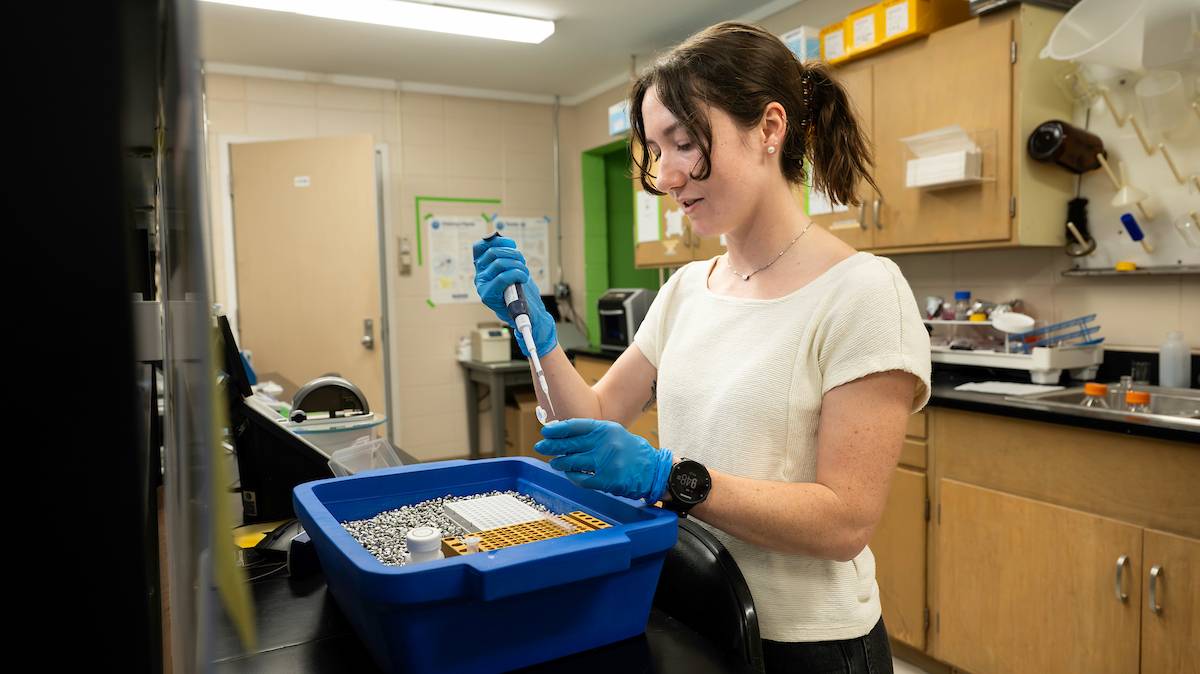
Ally Martin is studying the impacts of natural products on managed honey bee health.
The collaborative research will lead to healthier bees and crops—and a stronger agricultural future for Louisiana.
“The agricultural industry is a very large industry, and it supports a lot of jobs,” McCarthy said. “So, when the agricultural industry is not doing very well, then that could reflect in the jobs that people are able to do and also the food that we're able to consume, as well as a lot of products that may not be directly linked to honey bee, like cattle feed for example. You know, if we don't have honey bees, then maybe we can't feed the cattle we have, and that can have other effects that aren't quite obviously linked to honey bee.”
“Unless you have a really poor diet and you prefer not to have nutritious food, it is important to keep these colonies healthy and be able to make agriculture sustainable from the point of view of beekeeping and the production of crops in the future. So, I think it's a very important matter, and it needs to be taken seriously,” said LSU AgCenter Extension Associate Paula Castillo.
Discover stories showcasing LSU’s academic excellence, innovation, culture, and impact
across Louisiana.Next Step